
Picking a CRM shouldn't be complicated, but many business leaders struggle when evaluating Zoho vs HubSpot. Both platforms are powerful and have thousands of paying customers. Both can help you track leads, automate workflows, and manage your customer relationships. So how do you choose?
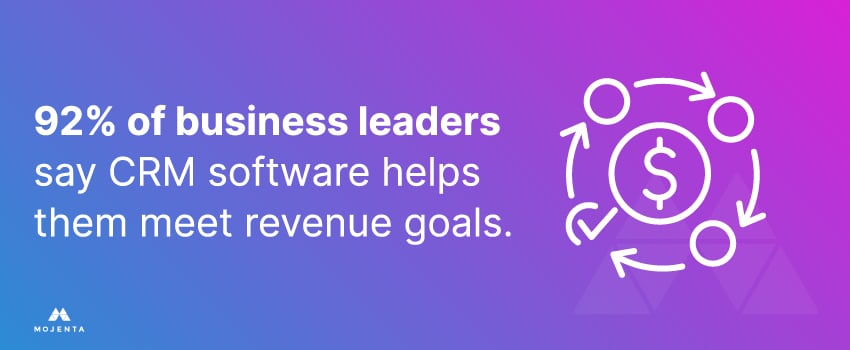
CRM adoption has become non-negotiable for most businesses. More than 90% of companies with 10 or more employees use a CRM, and 92% say CRM software helps them meet revenue goals.1 But there's a catch: picking the wrong platform for your needs can waste money, frustrate your team, and potentially slow down your growth.
Let’s break down HubSpot vs Zoho CRM – and see how they stack up against another popular competitor, Monday CRM – to help you determine which one makes sense for your situation.
HubSpot vs Zoho: High-Level CRM Comparison
Both HubSpot and Zoho are CRM platforms built to help sales, marketing, and support teams do their jobs better. But their approach is fundamentally different, and this difference shapes everything else.
HubSpot
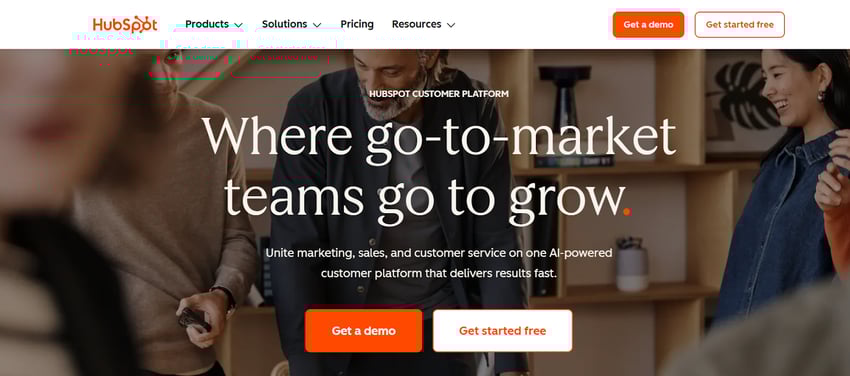
HubSpot is built for speed and simplicity, which makes it a great option for businesses focused on inbound marketing. You can open HubSpot, navigate the intuitive interface, and start tracking leads immediately. Plus, its free plan includes essential CRM features and scalable upgrades, so smaller companies can still get value from it without going over budget.
Zoho CRM
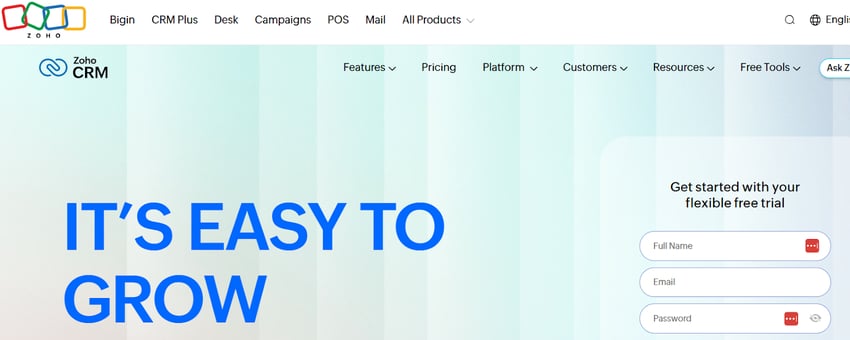
Zoho CRM provides teams with the tools to build what they need. It integrates with Zoho’s suite of products (like Zoho Books and Zoho Projects) and lets you customize practically everything. While this means more adaptability, it also means more configuration upfront and complexity down the road.
HubSpot CRM vs Zoho CRM: Features & Functionality
Here’s where HubSpot vs Zoho truly diverges, and where your specific goals will determine which one actually works better for your organization.
1. Ease of Use
- HubSpot‘s interface feels modern and clean. For teams that want to get value without learning a complicated system, this matters.
- Zoho CRM offers more complex navigation. It’s less intuitive for first-time users, but if you have the technical skills in-house, you get more customization and control.
Verdict: HubSpot takes the lead for ease of use – especially for sales and marketing teams who want to get up and running fast.
2. Customization
- HubSpot offers customization, but it comes with restrictions. Advanced customization often requires a developer and might cost you extra.
- Zoho CRM is very flexible. You can build custom modules, create complex workflows, set up field-level permissions, and configure Zoho to match almost any process you have.
Verdict: When flexibility matters most, Zoho CRM is the winner. HubSpot is flexible enough for most teams, but Zoho gives you more runway if you have complex sales processes.
3. Automation
- HubSpot’s AI tools integrate seamlessly with your CRM data and let you automate workflows and personalize messages at scale.
- Zoho CRM's AI tools are similar, but they sometimes feel like add-ons rather than native features.
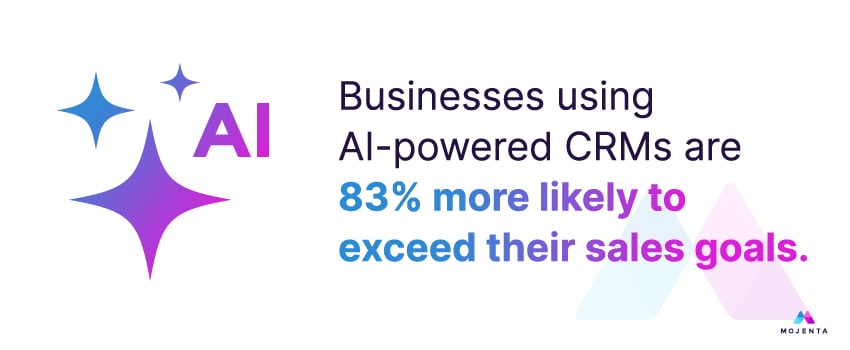
Verdict: HubSpot's AI features are more polished – a must-have, considering businesses that use AI in their CRM are 83% more likely to exceed their sales goals.3
4. Integrations
- HubSpot combines CRM, email, marketing automation, landing pages, and content management into one unified platform, and makes it easy to integrate with external apps.
- Zoho CRM integrates with marketing tools but lacks the seamless native marketing hub that makes HubSpot stand out.
Verdict: If you want your sales and marketing teams to work from a fully integrated martech stack, HubSpot makes that happen.
Zoho vs HubSpot CRM: Pricing Models
Both CRMs offer tiered pricing, but the differences in value add up. Here’s a quick overview:
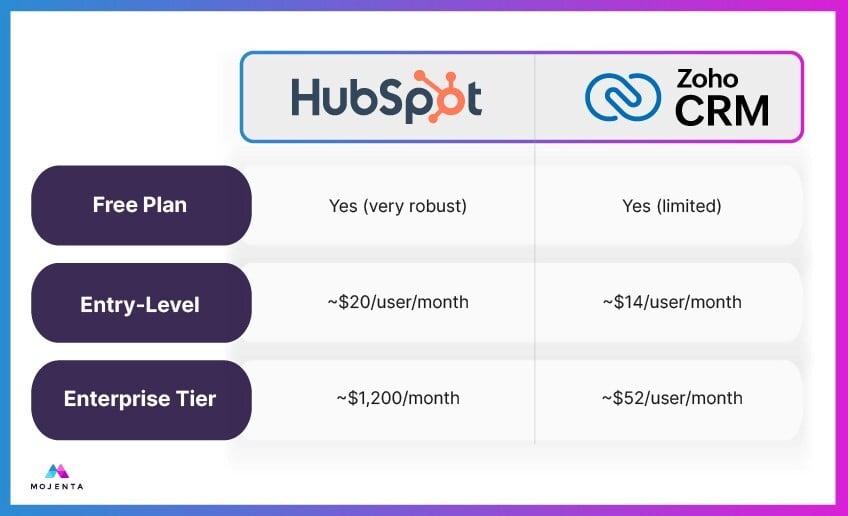
With HubSpot's free plan, you get a real CRM with lead tracking and basic automation. It's a legitimate option for small teams or startups testing the platform. But while Zoho's free plan is more limited than HubSpot's, its per-user cost stays significantly lower as businesses scale.
Verdict: If budget is your biggest concern, Zoho CRM wins. If you’re looking for sales and marketing integration and can justify the extra cost, HubSpot delivers more ROI in those areas.
HubSpot vs Monday CRM: How Do They Compare?
Teams exploring WorkOS-style CRMs have asked us about Monday vs HubSpot, and we’re here to deliver.
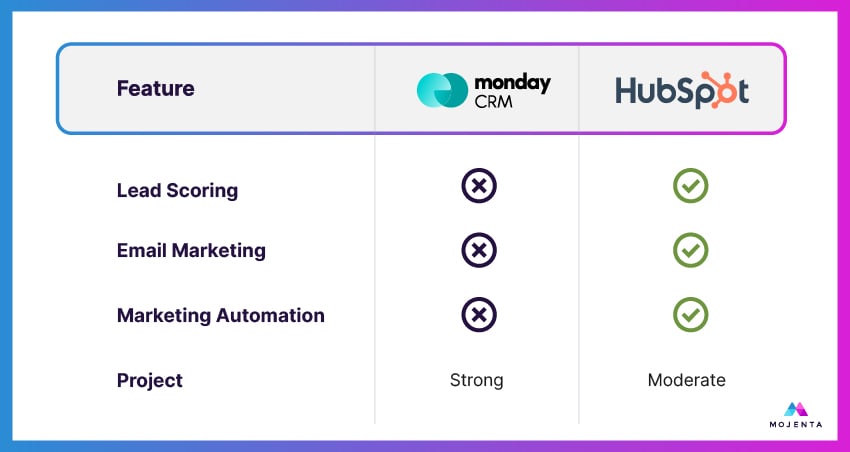
Monday CRM started as a project management tool and evolved into a CRM. It's helpful for teams that prioritize visibility across projects, but weaker on traditional CRM features like lead scoring, email marketing, and automations.
Verdict: If you’re looking for true CRM functionality, it’s a no-brainer: HubSpot wins on CRM-specific features. If project visibility is more important than marketing integration, Monday CRM is worth considering.
Monday vs HubSpot: Feature Breakdown
Tech Companies Comparing Zoho CRM vs HubSpot CRM
If you’re in tech, your CRM decision is likely tied to:
- Speed to scale
- Marketing/sales alignment
- Reporting and attribution accuracy
HubSpot excels here because of its unified platform and fast onboarding. You can spin up a fully integrated sales and marketing system in hours, and that speed matters when you're growing.
Still torn between Zoho vs HubSpot? Here are a few considerations to keep in mind:
Content Marketing Maturity
HubSpot's content management system and blogging tools are built directly into the platform. If your team is doing serious content marketing to support your inbound strategy, HubSpot makes that integration seamless. Your marketing team can publish blog posts, manage keywords, track performance, and connect all of it back to your CRM without jumping between tools.
Zoho can connect to content tools, but you're managing content separately from your CRM and manually connecting the data back. This disconnect can slow down tech marketers who rely on content to drive qualified leads.
Competitive Landscape
If you're competing in a crowded market, you need to understand which channels, campaigns, and sales activities actually drive revenue. HubSpot's reporting and analytics are built for attribution, forecasting, and reporting straight out of the box.
Zoho's reporting is capable, but HubSpot's is more mature and requires less configuration to get meaningful insights.
Internal Dev Resources
If you have developers on your team, you can leverage Zoho's customization capabilities to build exactly what you need. But without those resources, customization becomes expensive. You'll either spend money on professional services or external consultants to make Zoho work, or you'll run into limitations.
HubSpot requires less customization upfront, which means you can move faster without needing a dedicated technical resource to manage your CRM configuration.
Product and Buyer Sophistication
When you're selling to businesses, your buyers will expect integration capabilities and sophisticated reporting. They'll want to see how your solution connects to their existing stack. HubSpot delivers that integration depth out of the box with 1,700-plus available integrations. With Zoho, you might need to build or configure more of those integrations yourself.
Tool Sprawl
IT and tech providers often use dozens of tools. HubSpot's unified interface and integrations make it easier to keep everything connected without having to manage countless separate systems.
Zoho's integration options are extensive, too, but managing all those integrations requires more overhead and ongoing maintenance.
Zoho vs HubSpot CRM: Who’s the Winner in 2026?
Here’s a quick recap of the HubSpot CRM vs Zoho CRM decision:
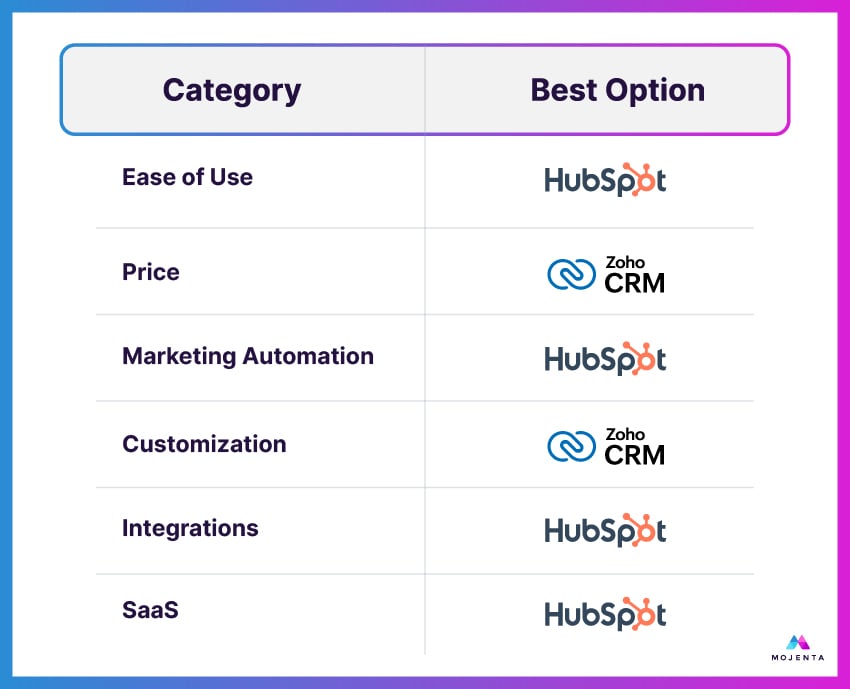
The honest answer is that both CRMs are good. The "right" choice depends on your specific situation.
Choose HubSpot if you're a growing business that wants speed, simplicity, and unified sales-marketing workflows. You’ll get your sales and marketing engines up and running without spending weeks configuring a system.
Choose Zoho if you're a more complex organization that needs flexibility, customization, and doesn't mind putting in configuration work to get exactly what you need.
Get Your CRM Right With Mojenta
Looking for a strategic partner to simplify your CRM selection, migration, or optimization?
At Mojenta, we’ve helped over 400 B2B SaaS and tech companies build revenue engines that scale – and we know that your CRM is at the center of it all. Whether you want to get the most out of HubSpot or explore other options, we’re here to guide you.
Let’s build your perfect CRM stack. Contact us today.
Sources:


/mojenta-feat-CRMforMSPs.jpg)