
Your SaaS product is solid, and your sales team is competent – but your website doesn't show up for the searches that matter. Meanwhile, your competitors are ranking for keywords you didn't know existed, and prospects are finding them instead of you.
Sound familiar? If so, you may be doing SEO wrong.
SEO isn’t dead. With 66% of B2B buyers using search results to research products before making a purchase,1 search is still an essential part of any B2B marketing toolkit. But enterprise SaaS SEO isn’t about chasing quick wins or ranking for a handful of keywords. It’s about building a long-term engine that supports pipeline growth and brand authority across your entire customer journey.
In this guide, we'll walk through how to approach SEO for SaaS companies and avoid the mistakes that sink most teams.
TL;DR
- Enterprise SaaS SEO is the practice of optimizing large, multi-product software websites, often spanning thousands of URLs, subdomains, and regional versions, so they capture high-intent organic demand from enterprise buyers and turn it into sales pipeline.
- It differs from traditional SEO by targeting long-tail, solution-specific queries instead of broad high-volume terms, because enterprise buyers research for months and involve several stakeholders. The average B2B SaaS company needs 54 touchpoints to generate an MQL after a first website visit.
- The technical foundation decides whether any of it works: crawl budget, indexation, JavaScript rendering, hreflang, Core Web Vitals, schema, and clean redirects all have to hold up across thousands of pages.
- Content has to cover the full funnel, from educational articles to comparison, alternatives, pricing, and integration pages. Programmatic templates scale the long tail, while keyword-to-page mapping keeps pages from competing with each other.
- Visibility now includes AI answer engines such as ChatGPT, Perplexity, and Google AI Overviews, which cite sites with clear entities, answer-first content, and consistent structured data.
- Success is measured in pipeline, meaning MQLs, SQLs, and revenue, rather than raw traffic. Results come from a consistent monthly program that compounds over time, not a one-quarter project.
What Is Enterprise SaaS SEO?
Enterprise SaaS SEO refers to search engine optimization strategies designed for large SaaS organizations with complex websites, multiple product lines, and competitive markets. Unlike early-stage SEO, enterprise SEO must account for scale, stricter governance, and multiple teams with different priorities.
Effective enterprise SaaS SEO connects search visibility to business outcomes. That’s why at Mojenta, we don't care about traffic for traffic's sake. We care about whether organic search is feeding your sales pipeline, whether it's driving the right-fit customers, and whether it's contributing to your revenue.

SEO for SaaS Companies Requires an Enterprise Approach – Here’s Why
SEO for SaaS companies differs from traditional SEO because buyers rarely convert after a single search. A 2024 study found that it takes the average B2B SaaS provider 54 touchpoints to generate an MQL after their first website visit.2 That’s because SaaS buyers research extensively, compare vendors, and involve multiple decision-makers before engaging with sales.
Your SEO strategy has to cover this entire journey. This means offering the right content at every touchpoint, including:
- Awareness-stage educational content
- Comparison and evaluation pages
- Product and feature-level search
- Technical documentation and support queries
Keep in mind that enterprise SaaS SEO doesn't work in isolation. Your sales team, product team, marketing team, and technical team all have a say in whether SEO succeeds. For example, one team can't be optimizing pages while another is blocking them from indexing. Coordination is critical.
Common SaaS SEO Mistakes Enterprise Teams Make
We see the same patterns repeat across enterprise organizations, and most of them are fixable once you know what you're looking for.
- Publishing the Wrong Content: If you’ve created something you think is valuable, but nobody's actually searching for that topic, you’re missing the mark on what your audience actually needs.
- Letting Pages Compete for Keywords: Your product page should own the keywords where you're selling. Your blog should own the keywords where you're educating. When you optimize both for "how to reduce churn," one of them is going to lose in Google's eyes, and neither ranks as well as it should.
- Ignoring Internal Linking: Links from other websites matter, but links from your own website are free authority you're throwing away. A few strategic links from your blog to your product pages can make a real difference in what ranks and how well it converts.
- Treating SEO as a One-Time Project: "We'll do SEO this quarter" is how you sabotage your results. The teams that win are the ones that say, "We're going to do this consistently, every month, for the next year." Then they actually do it.
- Over-Gating Educational Content: Gate your free trials. Gate detailed pricing guides. Gate product demos. But if your core educational content is behind a gate, you're hiding your expertise from search engines.
Fixing these issues usually delivers bigger gains than any new campaign you could launch.
6 Tips for Effective SaaS Marketing With SEO
Most enterprise SaaS marketing teams either neglect SEO completely or treat it like a quick fix. Neither approach works. Building effective SEO requires balancing immediate action with long-term discipline. Here’s how:
1. Start With Search Visibility
Paid media can generate quick results, but enterprise SaaS marketing relies on search for long-term, compounding returns.
Organic search builds credibility in ways paid media can't. Appearing in search results during the vendor evaluation stage builds trust before anyone even talks to your sales team. And it gets stronger the longer you invest in it, unlike paid channels, where results stop as soon as you stop spending.
2. Remember: SaaS Search Is No Longer Linear
Most teams still think about buyer journeys as linear. Awareness, consideration, decision. But that's not how SaaS works. A B2B SaaS buyer might:
- A buyer might search for a problem today
- Research solution categories next week
- Compare your product against three competitors the week after
- Check your pricing and look for customer reviews
And they may not talk to sales until month two or three of the process.
Modern SaaS search strategies must account for this non-linear journey. Enterprise SaaS SEO succeeds when content anticipates questions at every stage and connects them across the site.
3. Audit Site Performance Before You Scale
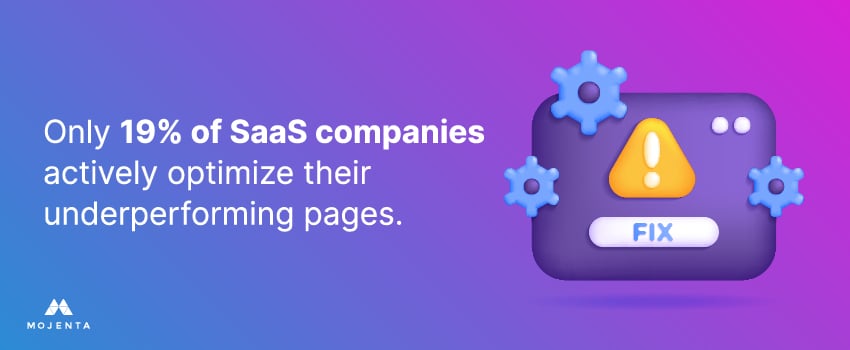
Before scaling content or link building, you need to audit your site’s SEO performance. Only 19% of SaaS companies actively optimize their underperforming pages, even though it can lift sitewide traffic by up to 15%.3
Audit SEO SaaS by looking at your website’s:
- Indexation and crawl efficiency
- Duplicate or thin content
- JavaScript and rendering issues
- International or multi-domain complications
- Conversion paths and UX barriers
At Mojenta, our audit SEO SaaS process prioritizes fixes that unlock growth rather than chasing vanity metrics.
4. Align With Your Growth Goals
Most teams miss their biggest opportunities by building content without connecting it back to what actually matters for the business.
Think about what enterprise SaaS marketing actually needs. Long sales cycles mean prospects are researching for months. If your SEO strategy only covers the last 10% of the buyer journey, you're leaving money on the table.
Not sure if your SEO strategy is effective? Mojenta helps SaaS providers create SEO strategies that align with your product, sales, and marketing efforts – so it can stop being a cost center and start being a growth engine.
5. Don’t Forget About Technical SEO
Enterprise SaaS teams often ignore technical SEO because it feels unglamorous compared to content creation. But technical problems can quietly undermine everything else you do. You might have the best content in your industry, but if search engines can't crawl your site properly, nobody will find it.
SaaS technical SEO typically includes:
- Core Web Vitals optimization
- Proper schema implementation
- Clean redirect logic during migrations
- Secure, scalable CMS configurations
Your site’s technical foundation has to support your content strategy effectively. When it doesn't, even great work will underperform.
6. Choose the Right SaaS SEO Tools
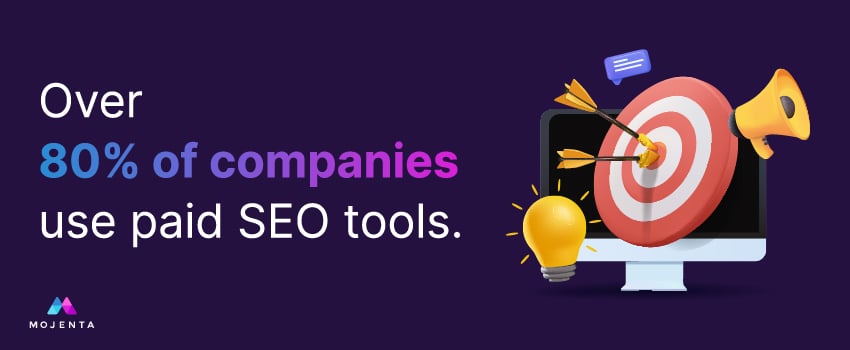
The right SEO tools don't fix strategy gaps, but they can make execution much faster and smarter. Over 80% of companies use paid SEO tools4 – because they have to. Free tools hit a ceiling when you're dealing with scale, and enterprise SaaS marketing teams need solutions that monitor site health across hundreds or thousands of pages.
The key is to use tools that surface insights and inform decisions without drowning your teams in too much data.
Bonus: Prioritize Authority, Not Volume, for Enterprise Link Building
Marketing teams tend to chase quantity instead of quality when it comes to enterprise link building. They pursue links from any old website, rather than sources prospects might actually care about.
Smart enterprise link building focuses on relevance and authority. You want links from sites that matter in your space. A link from a major industry publication is worth more than 50 links from irrelevant websites.
This could look like digital PR campaigns that get your research covered by industry publications, or original research that other companies want to reference and link to. Assets like these build your SEO profile while also establishing credibility with prospects. That's the kind of link building that matters.
How Enterprise SaaS SEO Works at Scale
The tips above cover what to prioritize. This section covers the structural work that separates enterprise SaaS SEO from a well-run blog: how content is organized, how pages are produced in volume, how a large site stays crawlable, and how results are tied to revenue.
Entity-First Content Architecture
Search engines and AI models understand a SaaS site through its entities: the product, the category it belongs to, the problems it solves, the industries it serves, and the tools it integrates with. An entity-first architecture gives each of these a dedicated hub page and links related pages to it in a consistent pattern, so the site's structure mirrors how buyers think about the product. Naming discipline matters as much as the hubs. When the same feature is called three different things across product pages, docs, and blog posts, engines treat it as three weak topics instead of one strong one.
Programmatic Pages for Integrations, Use Cases, and Alternatives
Programmatic SEO builds large sets of pages from a shared template and a structured dataset, which suits SaaS well: one page per integration, per use case and industry pairing, per template, or per competitor alternative. Each set targets long-tail queries that are individually small but collectively large and usually high in intent. The template is the easy part. The dataset is what makes each page worth indexing, such as setup steps, supported objects, or real feature differences. Pages that differ only by a swapped-in name become index bloat and pull crawl attention away from the pages that sell.
Crawl Budget and International Architecture
On a site with tens of thousands of URLs, Google will not crawl everything often, so the job is directing its attention. That means keeping parameter, filter, and internal search URLs out of the index, segmenting XML sitemaps by page type so indexation gaps show up per section, and keeping important pages within a few clicks of the homepage. International sites add hreflang, which only works when every language version references every other version, including itself. A missing return tag on one locale is one of the most common reasons the wrong country version ranks.
Optimizing for AI Answer Engines
ChatGPT, Perplexity, and Google AI Overviews now answer many of the category and comparison questions buyers used to type into a search box. These systems favor pages that state definitions plainly, answer before they explain, and describe the product consistently in copy and in Organization and SoftwareApplication schema. They also draw heavily on third-party sources such as review sites, analyst listings, and industry publications, so off-site mentions shape AI visibility as much as on-site content does. Tracking which prompts cite your brand, and which cite competitors instead, is now part of a standard SEO report.
Measuring SEO in Pipeline, Not Traffic
Tying organic search to revenue requires connecting analytics to the CRM so that every lead carries its original source and the pages it viewed before converting. With dozens of touchpoints before a lead converts, last-click reporting undercounts organic search badly, because the first visit is often an article read months before the demo request. Multi-touch attribution, page-group reporting, and a "how did you hear about us" field on demo forms each fill part of that gap. Teams that report only sessions and rankings tend to lose budget the first time leadership asks what search contributed to ARR.
SaaS SEO Checklist for Enterprise Teams
A scalable SaaS SEO checklist can help your marketing teams stay aligned and ensure nothing slips through the cracks. Make sure to include:
- Keyword-to-Page Mapping: Does each page have a clear keyword focus? Are multiple pages fighting for the same keywords? Get clarity to prevent cannibalizing your own rankings.
- Technical Health Monitoring: Are redirects clean and working correctly? Is your CMS creating indexation problems? Issues like these drift over time, so audit them regularly.
- Content Refresh Cycles: Which pages need updates? Which should be consolidated or removed? Ranking decay when old content gets stale.
- Internal Linking Audits: Are you connecting content so that it guides both users and search engines? Is authority flowing where it should, or are you losing it to less relevant pages?
- Conversion Rates: Traffic is only half the battle. You can drive 10,000 visitors to a page that converts at 0.1%, or you can drive 1,000 visitors to a page that converts at 5%. The second one is better. Which pages on your site aren’t converting? Find out, then start optimizing for more conversions.
Treat your SEO checklist as a living document. It should evolve as your business and search landscape change.
Build a Better Enterprise SaaS SEO Strategy With Mojenta
Enterprise SaaS SEO isn't something you can outsource and forget about. It requires strategy, coordination across teams, and commitment to consistent execution. And most importantly, it requires clarity on what success actually looks like for your specific business.
At Mojenta, we combine technical expertise, content strategy, and marketing alignment to drive sustainable SEO results. Our experts are here to help you:
- Build scalable SEO frameworks
- Improve technical performance
- Create search-driven content ecosystems
- Avoid common SaaS SEO mistakes
- Tie SEO performance directly to business outcomes
If you’re ready to turn search into a predictable growth channel – not just a traffic source – let’s talk. Contact our team to build an enterprise SaaS SEO strategy that delivers measurable results.
Enterprise SaaS SEO FAQs
How much does enterprise SaaS SEO cost?
Enterprise SaaS SEO retainers commonly range from about $7,000 to more than $60,000 per month. Where a program lands in that range depends on site size, the number of languages and markets, the amount of technical debt, and how much content is produced each month. Programs at the lower end usually assume an in-house team handles implementation, while the upper end includes engineering support, content production, and digital PR. The better comparison is not against other SEO quotes but against the cost of acquiring the same pipeline through paid search.
How long does enterprise SaaS SEO take to show results?
Most enterprise SaaS sites see early ranking movement within three to six months, with pipeline impact following later because sales cycles are long. Technical fixes such as indexation or rendering problems can show results within weeks once pages are recrawled. New content usually takes longer, especially in competitive categories. Agree on leading indicators upfront, such as indexed pages, rankings for priority keywords, and organic demo requests, so the program is judged on progress before revenue has had time to appear.
When does a SaaS company need an enterprise SEO approach?
A SaaS company needs an enterprise approach once its site becomes too large or too shared for one person to manage. Common triggers are several product lines, more than one language or market, thousands of URLs, or several teams publishing to the same domain. A single-product company with a few hundred pages usually gets more from focused content and basic technical hygiene than from enterprise governance. Adding process before the complexity exists slows teams down without improving results.
Should enterprise SaaS SEO be handled in-house or by an agency?
Most enterprise SaaS companies use a hybrid model, with an in-house lead who owns priorities and an agency that adds specialist depth. The in-house side holds product knowledge, stakeholder relationships, and access to engineering. Agencies bring technical auditing, content production capacity, digital PR, and experience across many sites. The arrangement fails most often when nobody inside the company can get SEO tickets into the development sprint, because recommendations then pile up unimplemented.
Should SaaS product documentation be indexed by search engines?
In most cases, yes: public product and API documentation should be indexable. Technical evaluators search for integration steps, API limits, and configuration details during vendor evaluation, and documentation is often the only page that answers those queries. Keep account-specific or customer-only content behind login, and make sure the docs platform renders content without depending on JavaScript that crawlers struggle with. Docs hosted on a separate subdomain with no links from the main site are a common blind spot, since they rank poorly and pass no authority back.
How often should an enterprise SaaS SEO strategy be revisited?
Review the full strategy once a year and the keyword-to-page map and priorities every quarter. Technical health needs continuous monitoring, because CMS releases and site changes introduce new issues without warning. Revisit the strategy outside the normal cycle after a product launch, a rebrand, a pricing change, or a site migration, since each one changes which pages should rank for what. A migration planned without SEO input is one of the most common causes of sudden organic traffic loss on enterprise sites.
Sources: